AIMTAS is delivered in three stages. Each stage de-risks the next — from a software-only farm, to one instrumented pilot, to a network of robotic farms run from a single hub.
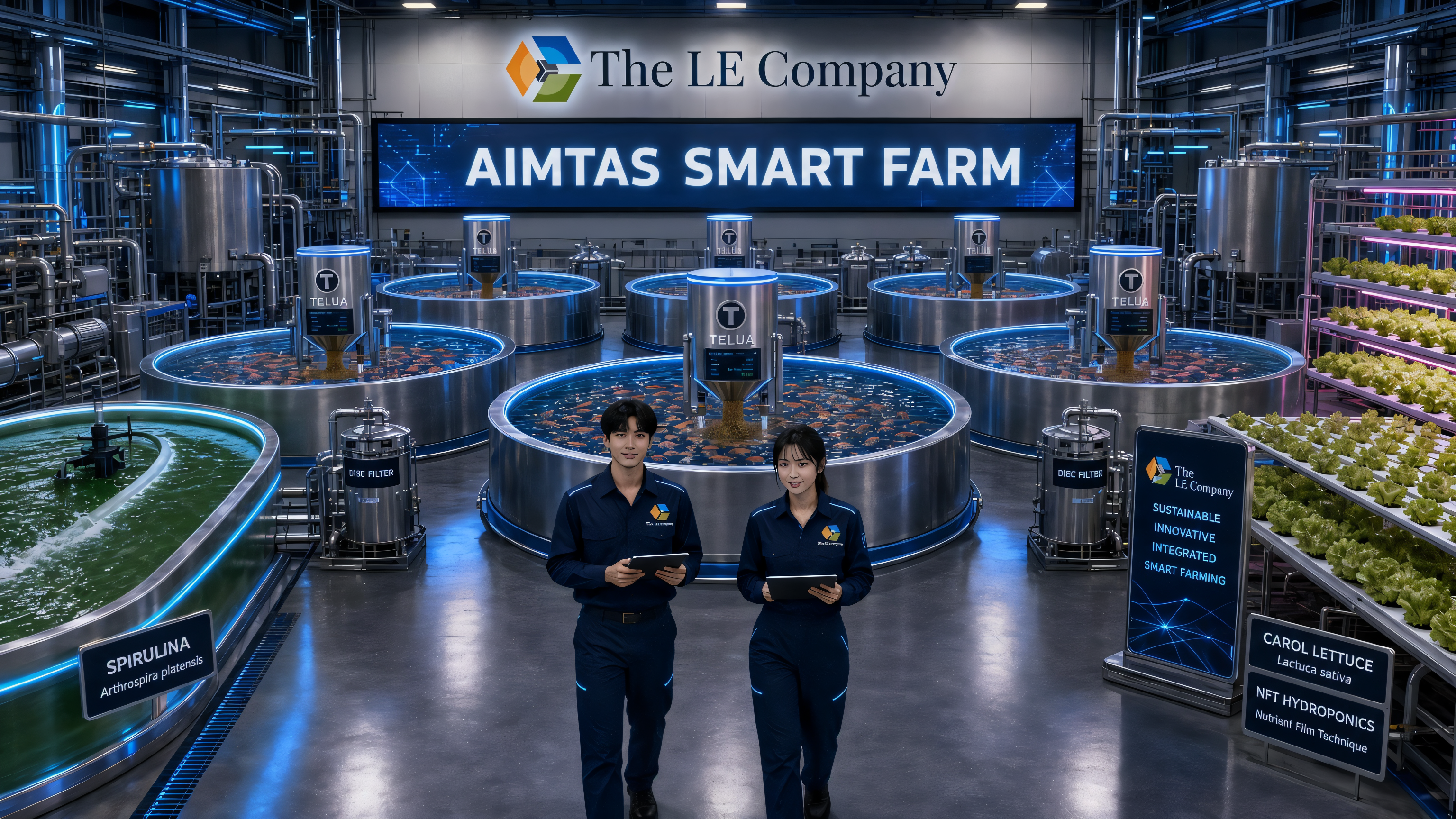
The video below is an illustration of the concept, not footage of a real farm.
🖥️
Stage 1In progress
Software Simulation & Digital Twin
BusinessProves the economics before any capital is committed: stocking density, feed cost, energy draw and cash flow are simulated per grow-out cycle, so the farm's P&L is on the table before the first tank is built.
TechnologyThe whole farm runs as software — the AIMTAS WoT Device Simulator drives virtual tanks, sensors and actuators as W3C WoT 1.1 Things over the real device protocol into the AIMTAS Edge Gateway, under the same Than Nong AI control logic, dashboards and alerts that will later run on-site.
AI modelTraining Than Nong AI's System One small language model, aimtas-laya-multilingual-GGUF, on the simulated farms' data and AIMTAS farm knowledge, so it already reads a farm before the first real tank is filled.
🧪
Stage 2Next
First Physical Pilot & Tuning Data
BusinessOne real farm turns the model into bankable numbers — yield per m³, OPEX per kg, labour hours per cycle — the evidence base for financing and for packaging AIMTAS as a repeatable blueprint.
TechnologyReal sensors (DO, pH, temperature, ORP, water level, flow) and actuators (pumps, aerators, feeders, valves) go live on the edge gateway. Field telemetry calibrates the Stage 1 models until Than Nong AI closes the control loop autonomously, with human override on site.
BusinessThe calibrated blueprint is replicated farm by farm from one operations hub: output scales with the number of sites while on-site headcount stays near zero — the margin engine of the model.
TechnologyRobots replace on-site workers entirely — feeding, harvesting, inspection and cleaning. Humans serve as remote technicians managing smart farms from a centralized hub, while Than Nong AI orchestrates end-to-end operations in direct coordination with the robotic systems.
What is AIMTAS?
How the AIMTAS platform is built
☁️
Cloud serverSkynet Than Nong AI
Every farm · stronger, larger models · System One and System Two run on cloud servers
⚡ System Onefast decisions (SLM)🧠 System Twodeep reasoning (LLM)
⇅summaries up · plans down
📍 On the farm · same site
🏠
Edge gatewayEdge Than Nong AI
One farm · System One and System Two can both run on a local machine here, so control keeps working with no internet
⚡ System Onefast decisions (SLM)🧠 System Twodeep reasoning (LLM) · also runs on the local machine
⇅readings up · commands down
🐟
The farmWoT devices
Sensors, pumps, aerators, feeders — W3C WoT 1.1
Today, while the models are being trained: System One runs on Hugging Face and System Two on OpenRouter — for both the edge and the cloud.
Three layers, one platform. The farm's equipment talks to the platform as W3C WoT devices. On the farm, the edge gateway runs Edge Than Nong AI — System One for decisions in about a second, System Two for deeper reasoning — so control keeps working even without internet. In the cloud, Skynet Than Nong AI runs the same pair across every farm with stronger, larger models, learning from all of them and sending plans back down.
AIMTAS (Autonomous Integrated Multi-Trophic Aquaculture System) is an advanced closed-loop production system seamlessly integrating:
Recirculating Aquaculture System (RAS) technology
Aquaponics (NFT hydroponic vegetable cultivation)
Algae cultivation (Spirulina raceway)
Solar-powered energy system (150kW)
AI-driven monitoring & autonomous control (Than Nong AI Platform)
Full W3C Web of Things (WoT) 1.1 support
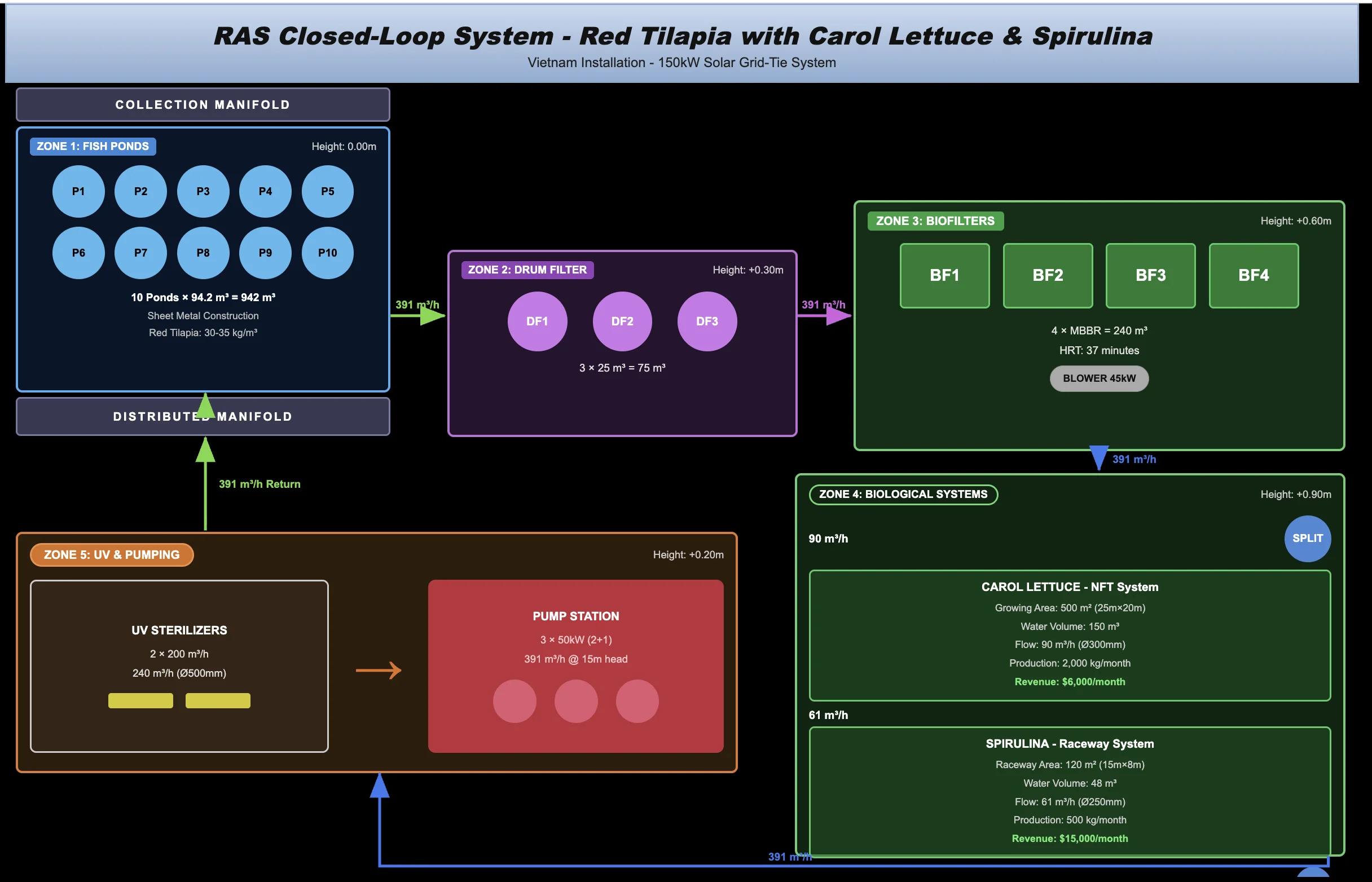
The system achieves 90% water recycling, produces 85,000 kg fish, 24,000 kg vegetables, and 6,000 kg Spirulina annually with minimal human intervention.
🔌 Device integration via W3C WoT Thing Description 1.1
AIMTAS is built on Web of Things (WoT) 1.1 — the official open standard from W3C for IoT devices. Put simply: your equipment does not have to come from us to work with AIMTAS.
What that means for your business:
Keep the equipment you already own. Pumps, blowers, feeders, water-quality sensors — if they support WoT 1.1 they can join AIMTAS directly, with no need to replace a working installation.
No vendor lock-in. Choose hardware on price and quality instead of being tied to one supplier's bundle. Equipment from different manufacturers runs side by side on the same farm.
Far lower integration cost and lead time. Because devices describe their own capabilities in a standard way, we do not write bespoke software per model. Adding a new class of device carries almost no development cost.
A long-term investment that holds its value. WoT is an open W3C standard owned by no single company, so your system does not depend on one supplier's product lifecycle or pricing decisions.
We are looking to work with:
Device manufacturers who want their products to run on a smart-agriculture platform without building a separate integration for every partner.
System integrators who need a hardware-neutral platform to deploy across many customers with many different device types.
Farms and production facilities that have already invested in equipment and want to add monitoring, automation and AI without discarding what already works.
Technically the integration is straightforward: the device publishes a standard description (a Thing Description) listing the values it measures and the operations it can perform; AIMTAS reads that description and builds the matching monitoring, control and alerting automatically.
🧪 Every device is proven against a simulated fleet first
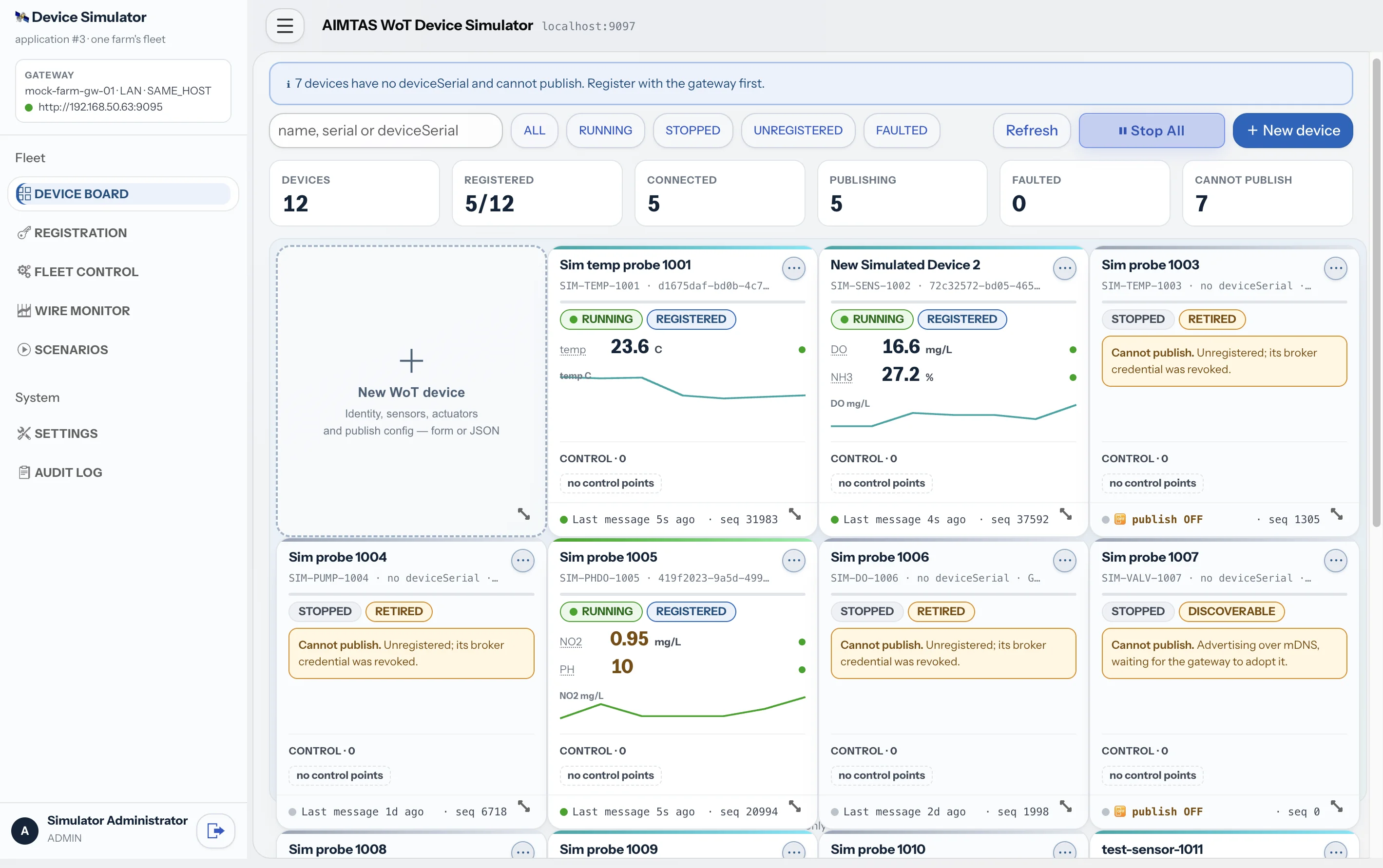
AIMTAS is delivered as three applications that run side by side. One of them, the AIMTAS WoT Device Simulator, reproduces an entire farm's fleet of WoT devices in software — each simulated device is a live card on one board — and speaks to the on-farm gateway over exactly the same messaging contract as physical hardware.
Application
Role
Cloud AIMTAS
Portal, data ingest, cross-farm analytics and Than Nong AI
AIMTAS Edge Gateway
On-farm normalisation, signing, routing and local autonomous control
AIMTAS WoT Device Simulator
Simulates one farm's WoT device fleet over the real device protocol
What the simulator buys the business:
Integration trials with no hardware, no pond and no site visit. A partner's device is modelled from its Thing Description and driven against the live platform, so the product is seen working on AIMTAS before a single unit ships.
Failure cases on demand. Fourteen named fault scenarios — a probe whose clock has drifted, a controller that reboots and restarts its message counter, a valve that refuses a command, a radio that drops without disconnecting — are reproduced by name. Equipment that only ever behaves well proves very little; AIMTAS is validated against the events that actually cause losses on a farm.
Training and tuning data for Than Nong AI. Simulated farms generate labelled operating history far faster than real ponds can, including incidents nobody would stage with live fish.
No privileged path for simulated devices. Same protocol, same adoption procedure, same message plane — so when physical equipment takes over in Stage 2, nothing above the device layer is rebuilt.
Implementation status: the WoT 1.1 interface contract is fully specified in the system design; the edge gateway and the device simulator are being built out alongside the PoC phase. If you are interested in partnering or would like to trial a device integration, please get in touch.
6 Key System Achievements
🔄
Resource Independence & Climate Resilience
90% water recycling rate — uses only 94.2 m³/day for a 942 m³ system
Solar-powered operation (150 kW) achieves 50% energy self-sufficiency
Closed-loop design eliminates dependence on natural water bodies
🛡️
Superior Food Safety & Quality Control
Real-time monitoring of water quality (pH, DO, ammonia, nitrite, nitrate)
Controlled environment — zero industrial pollutants, zero antibiotics
📦
Guaranteed Stable Production
85,000 kg fish + 24,000 kg vegetables + 6,000 kg Spirulina annually
95% survival rate vs. 70–80% in traditional farming
Continuous 24/7 automated operation
🤖
Advanced Automation & AI-Driven Intelligence
Simulated in software first — the whole stack (AIMTAS WoT Device Simulator → AIMTAS Edge Gateway → Cloud AIMTAS) runs end-to-end before a single tank, pump or sensor is bought, so the automation is proven with zero capital at risk
Simulated and real devices look identical to the platform (WoT Thing Descriptions, same messaging contract) — physical hardware drops in later with no rebuild of the layers above it
The simulator is how the AI is trained and hardened: simulated farms run faster than real time and inject fourteen named device faults on demand — drifted clocks, rebooting controllers, refused commands, dropped radios — generating the agriculture-specific dataset Than Nong AI is fine-tuned on
Two tiers in operation — Edge Than Nong AI decides and acts on site in real time (even offline); Skynet Than Nong AI predicts, optimizes, warns of disease early and learns across every farm, with SCADA executing its recommendations autonomously
🛒
Digital Marketplace & Direct-to-Consumer
All products sold via nongtrang.vn — real-time inventory & automated ordering
Farm-to-Table transparency: live production data, quality certificates
Smart pricing algorithm based on supply-demand analytics
👷
Minimal Human Labor Dependency
Automation bots handle almost every repetitive operational task end-to-end — the farm runs near-fully automated around the clock
AI + SCADA orchestration significantly reduces manual intervention
Human teams focus on supervision, quality control, and exception handling
AI Capabilities
Than Nong AI runs in two tiers — one on the farm, one in the cloud. Same capability, different scope.
On site · one farm
Edge Than Nong AI
Runs on a single box at the farm, on the local network, right beside the equipment it watches over.
Scope is one farm. It sees and commands only the devices of the farm it is installed on — the blast radius is limited by design, not by policy.
It keeps working when the internet does not. Readings, alarms, interlocks and the operator console stay live on the farm LAN through an outage; nothing waits on a data centre.
It reacts in seconds. Oxygen collapsing at 3 a.m. is a local decision — aerators on now, not after a round trip to the cloud.
It buffers and signs. Every reading is queued and cryptographically signed on site, then delivered when the link returns: an outage costs latency, never data.
It improves with every day of operation. A self-learning loop runs on site: each night the edge tier reviews the day's record — the readings it captured, the commands it issued and how water, plants and fish actually responded — and feeds those outcomes back into its local models. Dosing, feeding and alarm thresholds are recalibrated from the farm's own operating history, so control quality improves with every production cycle.
Cloud · every farm
Skynet Than Nong AI
Runs in the AIMTAS portal inside iAttendance.co, with the full operating history of every farm in the company.
Scope is the whole fleet. One board holds every farm, region and cluster — with per-farm oxygen, pH, temperature, power and link state side by side and every open alarm in one queue.
It learns across farms. A disease signature, a pump failure pattern or a feeding curve discovered on one farm immediately improves the models of all the others. This is the asset that compounds with every farm added.
It predicts instead of reacting. Early disease warning, growth and harvest forecasting, feed-conversion and energy optimisation, maintenance called before the part fails.
The heavy work lives here. Model fine-tuning, cross-farm analytics, the 3D digital twin, the farm builder and the automation designer all need compute and fleet-wide data — so they run where both exist.
One place to govern. Alarm rules, thresholds, roles and permissions are set centrally, and every command — human or AI, cloud or edge — lands in a single audit trail.
Live today · System One SLM model
Than Nong AI models — Laya
Than Nong AI thinks in two systems: System One, a fast decision model, and System Two, a large language model that reasons.
⚡System One answers typed farm questions in about a second — how urgent, which equipment, what matters — in English, Vietnamese, Japanese, Korean and Chinese.
🧠System Two takes over only when a case needs deeper reasoning; safety checks in code always have the final say.
ResilienceA cut fibre or a dead 4G modem must never stop aeration, feeding or alarms. The tier that keeps fish alive sits on the farm; the tier that makes the farm more profitable sits in the cloud. Losing the link degrades optimisation, not survival.
Operating costHigh-rate raw telemetry stays on site; only distilled, signed messages travel upward. Bandwidth and cloud bills scale with insight rather than with sensor count — which is what makes a farm of a hundred ponds affordable to run.
Speed and depth togetherReflexes need milliseconds and local context; forecasting needs years of history from many farms. Neither tier is asked to do the other's job, so we never trade a fast response for a smart one.
AccountabilityHuman and AI have identical capability and differ only in scope, and every action is attributed and logged. An operator can always see what the AI did, why, and undo it — the precondition for handing over real control in Stage 3.
Scale economicsFarm fifty adds one edge node and one 3D model, while the cloud tier gets sharper from its data. Cost per farm falls as the intelligence rises — the mechanism behind the margin in our replication model.
📊
Edge
Real-time Sensing & Alarming
Dissolved oxygen, pH, ammonia, nitrite, temperature, power draw and link health are read continuously per tank and per zone, time-corrected against gateway clock offset and raised as alarms the moment a value leaves its safe band.
🔮
Cloud
Predictive Intelligence
Early disease warning from combined water-quality and behaviour trends, harvest-date and biomass forecasting, and maintenance scheduled from degradation signals instead of a calendar.
🤖
Edge + Cloud
SCADA Automation with Interlocks
Automation is designed in the cloud and executed on the farm. Every command — whoever issues it — passes the gateway's guard chain and hard interlocks, so an unsafe action is refused at the equipment, not debated afterwards.
🍽️
Edge + Cloud
Smart Feeding
Feed is dosed per tank from growth stage, water temperature, oxygen headroom and appetite response. Feed is the largest operating cost in aquaculture, so every point of feed-conversion gain goes straight to the bottom line.
🧪
Cloud
Trained in Simulation
Than Nong AI is fine-tuned on labelled operating history generated by simulated farms running faster than real time, including fourteen named device faults nobody would stage on live fish.
🧭
Cloud
3D Digital Twin
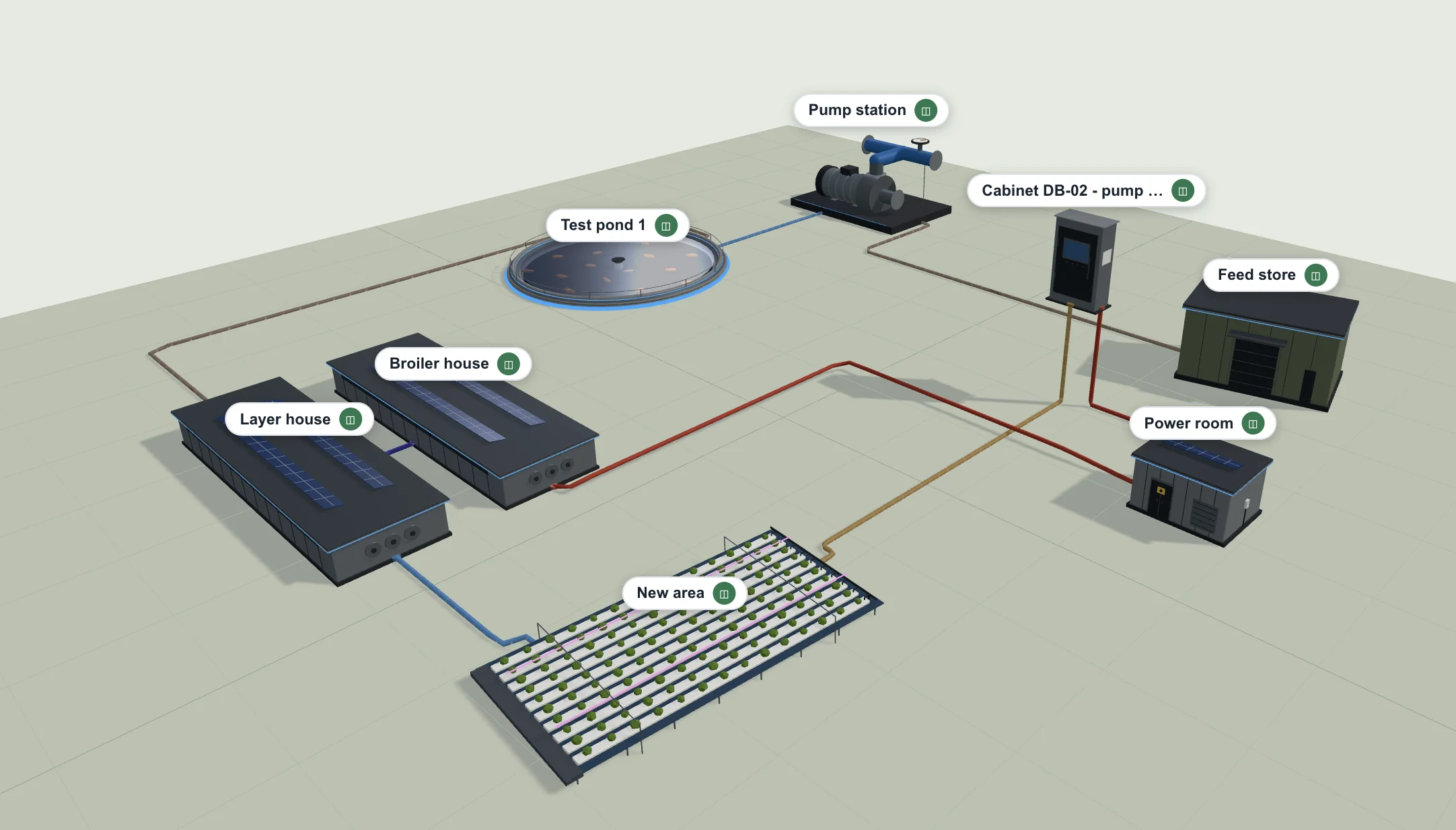
Ponds, houses, pump stations, cabinets, power rooms and every pipe and cable run are modelled in 3D, so both the AI and a remote technician reason about a real layout — the foundation for operating farms from a central hub.
RAS Closed-Loop System Design
Red Tilapia · Carol Lettuce · Spirulina — Vietnam Installation · 150kW Solar Grid-Tie
Annual Production & Revenue
🐟
Red Tilapia (Cá Rô Phi Đỏ)
Annual85,000 kg
Price/kg$2.04
Revenue$173,400
41.1%
🥬
Carol Lettuce (Xà Lách Carol)
Annual24,000 kg
Price/kg$2.80
Revenue$67,200
15.9%
🌿
Spirulina (Tảo Xoắn)
Annual6,000 kg
Price/kg$28.15
Revenue$168,900
40.0%
Total Annual Revenue$421,700 / year
By-products: 60,000 kg @ $0.19/kg = $11,400 (2.7%)
Investment Breakdown
Category
Description
Cost (USD)
Civil Works
Site preparation, Building structures
$90,000
Fish Ponds (10 units)
Sheet metal tanks, Installation & coating
$105,000
Filtration Systems
Drum filters, MBBR biofilters
$150,000
Aquaponics System
NFT channels & frames (500 m²)
$85,000
Spirulina System
Raceway construction (120 m²)
$50,000
Treatment & Pumping
UV sterilizers, Main pumps (50kW), Blower (45kW)
$90,000
Piping & Valves
PVC/HDPE pipes, Flow meters
$85,000
Electrical System
Solar panels 150kW, Grid-tie inverters
$140,000
Control System
SCADA system, sensors network, AI integration
$55,000
Fish Stock
Red tilapia fingerlings, First year feed
$67,500
Other Costs
Project management, Contingency (10%)
$170,000
TOTAL INVESTMENT
$1,087,500
Key Financial Metrics
$1,087,500Total Investment
$421,700Annual Revenue
$180,000Operating Expenses
$241,700Net Annual Profit
57.3%Profit Margin
4.5 yrsROI Period
Investing more in a larger AIMTAS farm will shorten the ROI period, as our cost-efficient software system is designed to significantly reduce operating costs with increased farm size.
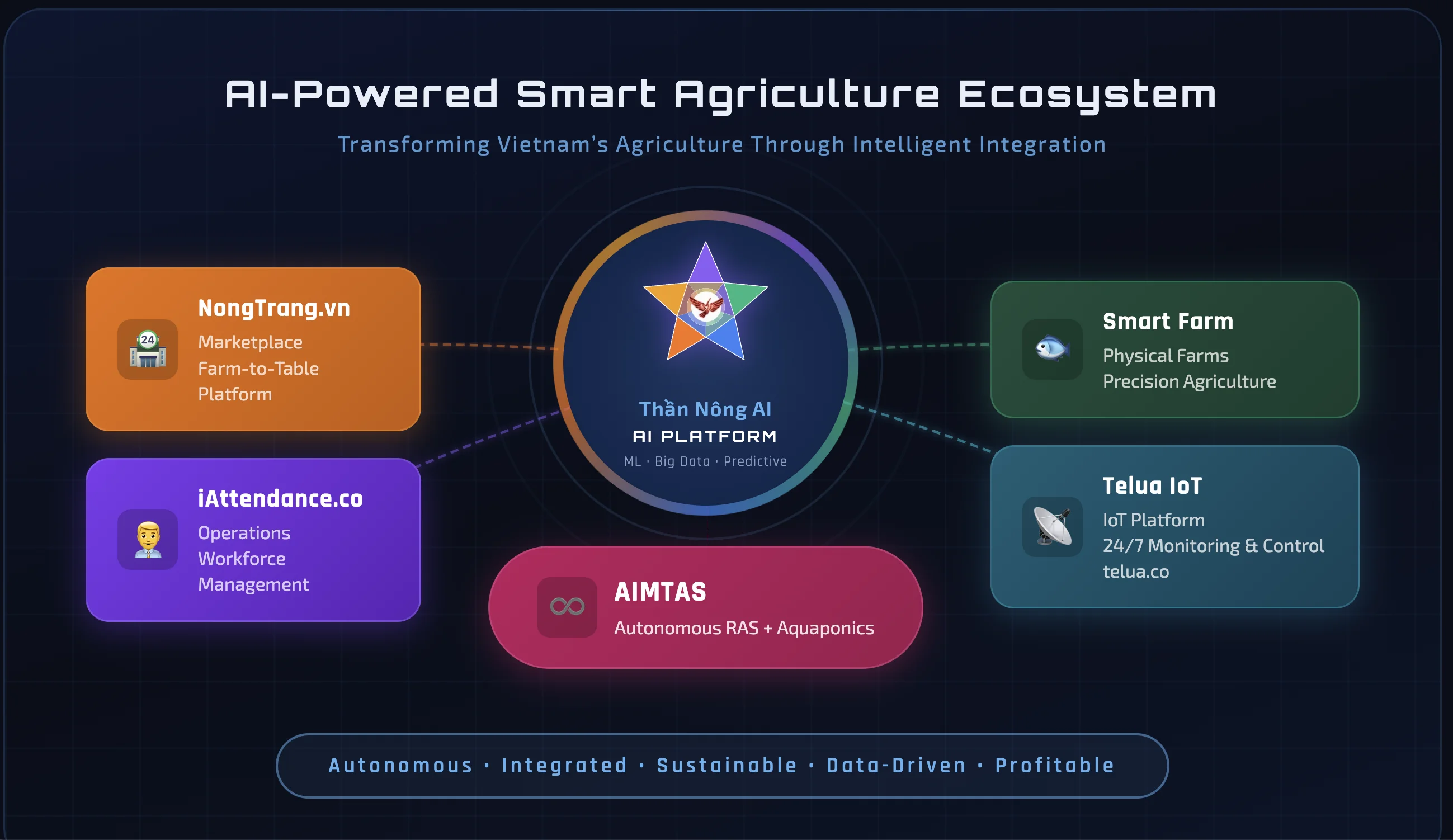
Digital Ecosystem
AIMTAS is backed by a fully integrated digital platform
🛒
nongtrang.vn
Online Marketplace for Farm Products
Farm-to-table e-commerce connecting AIMTAS production directly to consumers
Expanding to host 1,000+ verified agricultural suppliers across Vietnam by 2027
Farm Resource Management Platform — and the home of Cloud AIMTAS
AIMTAS is now integrated into iAttendance.co: the AIMTAS Farm module runs inside the same portal, so farms, devices, alarms, people and payroll share one login, one company structure and one audit trail
Cloud-based operations management — feeding, maintenance and harvesting tracking — now sitting next to live device telemetry and Than Nong AI instead of in a separate tool
Mobile app integration, scalable to 10,000+ agricultural facilities
High upfront costs for technology and infrastructure
Research and development expenses
Access to capital and financing options
Progress & Milestones
We are in Stage 1: the farm and the software that runs it are being proven in simulation, before any capital goes into concrete and steel.
Now · Stage 1
All three AIMTAS applications are running end to end — the cloud portal, the on-farm edge gateway and the WoT device simulator — with a fleet of simulated farms, devices and faults behind them. The screens below are captured from the working software, not mock-ups.
App 1
🎛️
Device Simulator
A whole farm's equipment — tanks, sensors, pumps, feeders — running as software.
⚙️ Equipment onlyNo AI here — it only simulates how real machinery behaves, running Training Profiles loaded from the cloud
Stands in for real hardware today
Can be told to break, on demand
↓readings up commands down
App 2
🏠
Edge Gateway
The box that sits at the farm and runs it, internet or no internet.
🧠 Edge Than Nong AIActs on the spot in seconds, powered by the System One decision model aimtas-laya-multilingual-GGUF
Watches one farm only
Keeps working during an outage
↓summaries up plans down
App 3
☁️
Cloud Portal
Every farm on one screen, inside iAttendance.co.
🧠 Skynet Than Nong AILearns from every farm
Forecasts, warnings, reports
3D twin of each farm
In Stage 2 the first box is simply swapped for real equipment on a real farm — everything to the right of it stays exactly as it is.
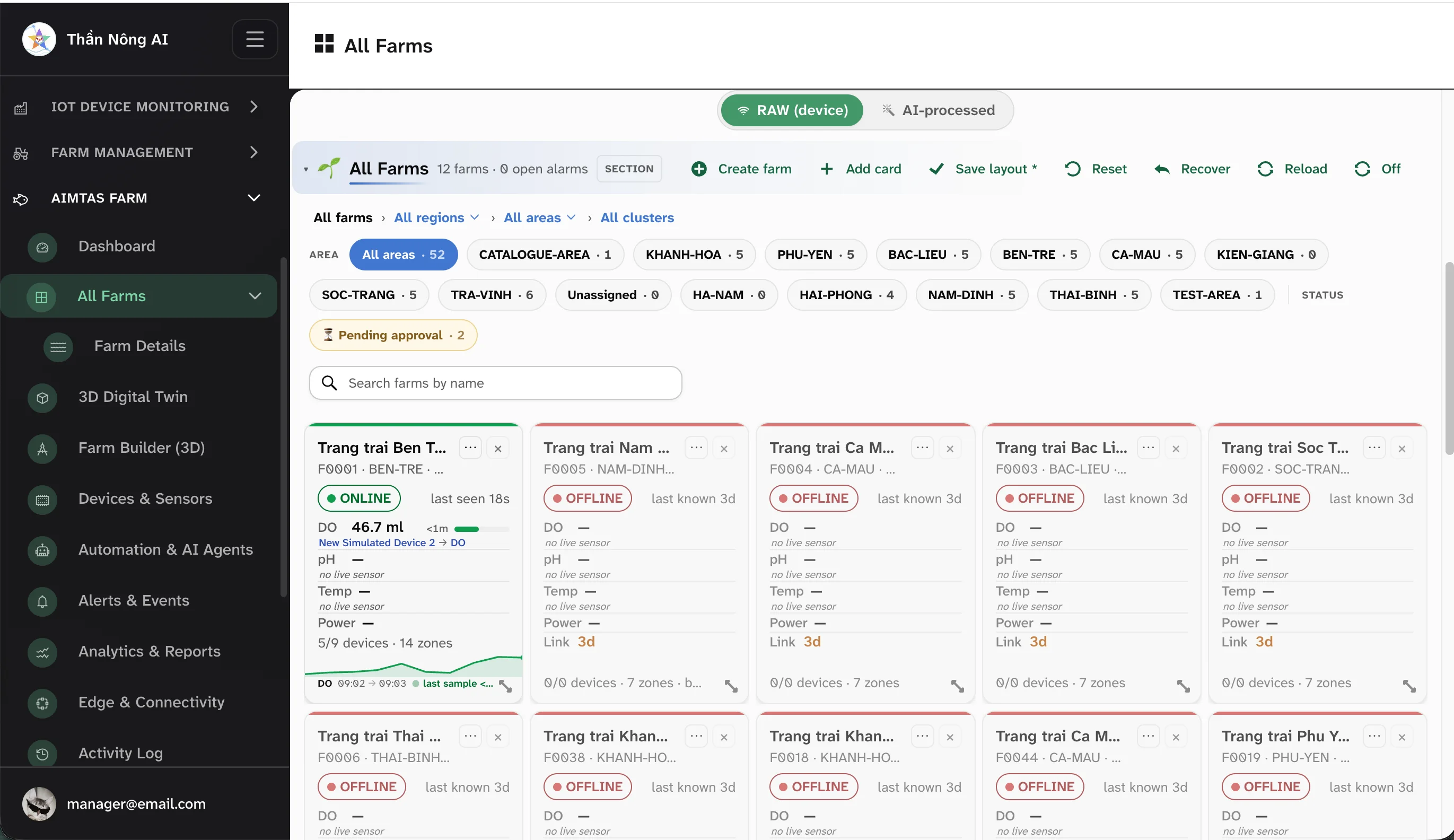
1Cloud AIMTAS — fleet dashboard
Twenty simulated farms across twelve provinces on a single board: oxygen, pH, temperature, power and link state per farm, device and zone counts, and every open alarm in one queue. The same portal carries the 3D digital twin, farm builder, device registry, automation and AI agents, analytics and the edge-connectivity view.
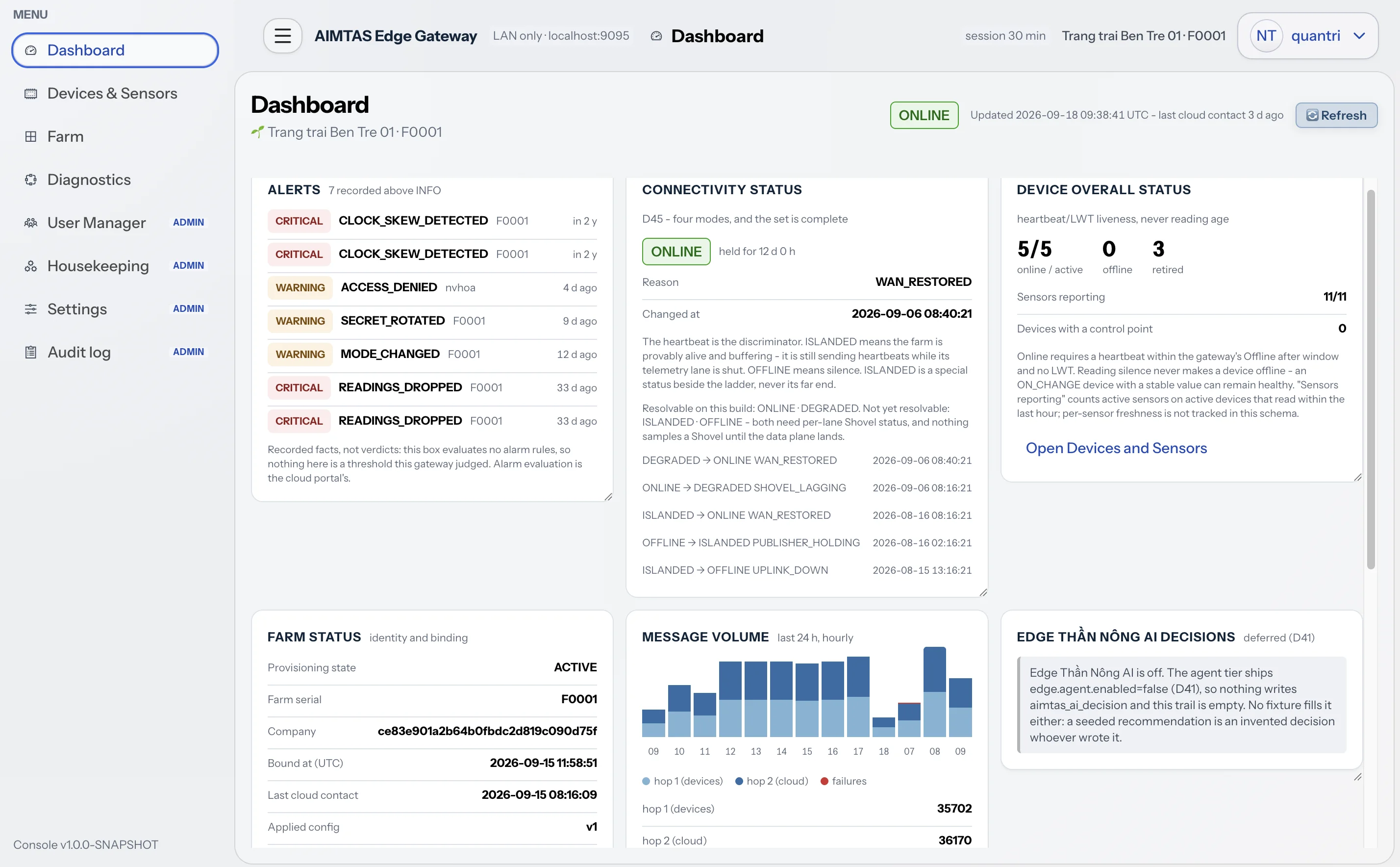
2AIMTAS Edge Gateway — on-farm console
The LAN-only console of one farm: provisioning state and cloud binding, applied configuration version, clock offset, hourly message volume split between devices and cloud with failures counted, and a live activity log. Note the degraded banner and the Edge Than Nong AI panel declaring itself off — the gateway reports what is true, including about itself.
3WoT Device Simulator — one farm's device board
Nine of a farm's devices running as software: pH/DO probes, an aerator, temperature probes, a valve, level and salinity sensors — each card declaring its own readings, link state, message count and the control points the gateway has set. Six of nine are registered with the gateway, one is running an injected fault and three have no deviceId yet so they are not allowed to publish — exactly the cases that produce the labelled dataset Than Nong AI is fine-tuned on.
4Cloud AIMTAS — 3D digital twin
A farm modelled in the browser: test pond, livestock houses with rooftop solar, pump station, distribution cabinet, power room, feed store and hydroponic beds, wired together with water, return, power and nutrient runs. Devices attach to these objects, so an alarm points at a place on the farm rather than at a device ID.
✅
Physical Groundwork Done
Experimental farm built and operational
Auto-feeding machine designed and manufactured in Vietnam by Telua
Custom drum-filter filtration system built and being refined
✅
Digital Platforms Live
nongtrang.vn — farm-produce marketplace live
telua.co — IoT platform with farm sensor control active
iattendance.co — farm operations management live, now hosting the AIMTAS module
✅
Cloud AIMTAS Running
Fleet dashboard, farm and device registry, 3D digital twin and farm builder are up inside iAttendance.co, driven by simulated farms — as shown above.
🔄
In Progress — Edge Gateway
On-farm console, device adoption, signed two-hop telemetry and command dispatch are being completed. The Edge Than Nong AI tier stays switched off until its hard-interlock veto evaluator is validated.
🔄
In Progress — Simulation & AI Tuning
The WoT device simulator drives virtual fleets and fourteen named fault scenarios to generate the labelled dataset Than Nong AI is fine-tuned on.
⏭️
Next — Stage 2 Pilot
First physical pilot farm with real sensors, pumps and feeders, to gather the tuning data that calibrates the simulated models against water and fish.
Partners & Collaboration
Help bring AIMTAS Stage 2 to life. We are inviting aquaculture farms, equipment manufacturers, technology partners, and investors to join our Stage 2 pilot. Together, we will validate AIMTAS in real-world conditions, generate measurable operational and financial results, and build a scalable blueprint for intelligent aquaculture.